The Leaky Bucket: Why You're Losing 70% of Your Best Leads
Founders and revenue leaders alike are obsessed with one thing: more leads. "If we just fill the top of the funnel," the thinking goes, "the revenue will follow."
So, you pour cash into PPC, SEO, and aggressive outbound campaigns. And it works. The leads start trickling, then flowing in. But then, something painful happens.
They vanish.
Not the cold, unqualified prospects who were never going to buy anyway. I'm talking about the good ones. The ones who read through your website, downloaded the whitepaper, and decided to give it a try. They click the CTA button, move a step or two, and then... silence.
This isn't just unfortunate; it's expensive. Losing a qualified lead mid-funnel is exponentially more painful than never getting them in the first place. By the time a prospect reaches the middle of your funnel, they are carrying the weight of your entire customer acquisition cost. When they drop off, all that investment evaporates.
While everyone is fighting a bloody battle for more top-of-funnel volume, the biggest opportunity for revenue growth isn't outside your company—it's sitting right inside your leaky conversion funnel.
The Brutal Reality: The "Activation Gap" is Where Revenue Dies
We need to talk about the most painful metric in SaaS. It isn't your Cost Per Lead (CPL) or even your churn rate. It's your Activation Gap.
I see many founders celebrating "Signups" as a victory. But in the self-service world, a signup is just a vanity metric. The reality is that about two-thirds (60–75%) of your qualified leads drop off before they ever finish activation.
These aren't "window shoppers." These are people who saw your ad, understood your value proposition, and wanted to use your product. But they hit a wall inside your own app.
The 3 Critical "Micro-Moments" of Failure
We can pinpoint the exact moments where these qualified leads vanish and look at them as a series of specific, fixable process failures.
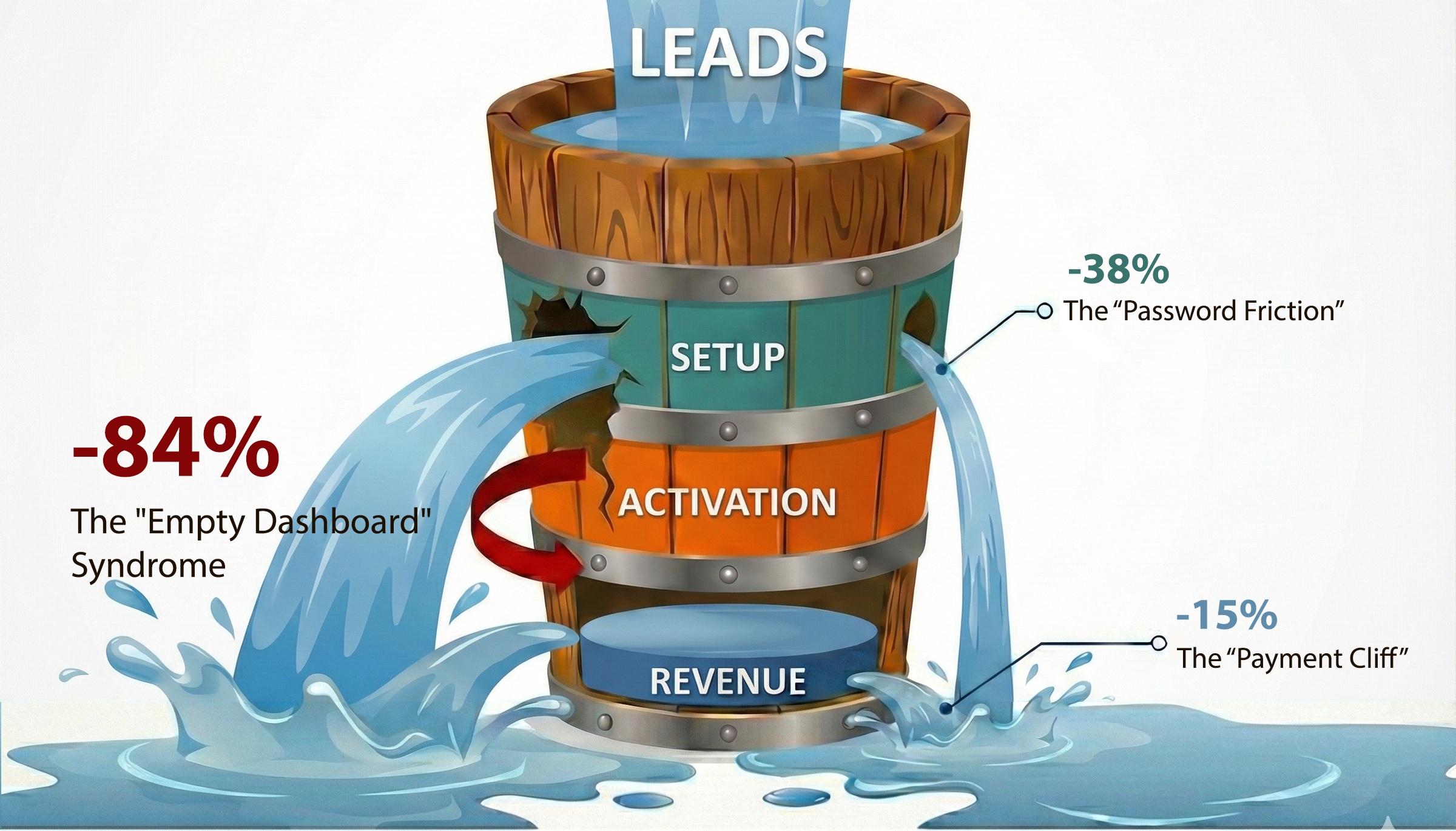
1. The "Password Friction" (The First 38% Drop). You think your signup form is simple. It isn't. Data shows that moving from the first stage of a signup process to the second often sees a 38% drop-off. Even asking for a password too early can cause abandonment rates to spike right at the gate.
Every extra field is a hurdle. If you are asking for a phone number or company size before they've even seen the product, you are prioritizing your database over their experience.
2. The "Empty Dashboard" Syndrome (The 84% Killer). This is the single biggest revenue killer in self-service SaaS. The user successfully logs in. They expect a solution. Instead, what they see is more work: another twenty-step wizard, a terrifying spaceship of various settings to be sorted, or a quilt of empty widgets.
Your new user thinks, "Okay, this is going to take some time. I'll do it tomorrow." And then – they never come back.
Userpilot data suggests that up to 84% of users abandon an app within the first session if they are greeted by an empty state without clear guidance.
3. The "Payment Friction" Cliff (The Last 15%). They activated. They liked the product. They are ready to pay. But then you force them into a complex checkout flow.
Even at this final decision stage—where intent is highest—we see a 10–15% drop-off. This happens because of surprise hidden costs, a 12-field credit card form, or a "Contact Sales to Upgrade" button that stops a self-service buyer dead in their tracks.
The Speed Imperative: An Anecdote on Winning
At my previous company, 8 out of 10 of our biggest customers came from inbound, and we knew for a fact that we won at least half of those deals simply because we were the first to react.
In the mid-funnel, time is your enemy. When a qualified lead raises their hand—requests a demo, asks for pricing—the clock starts ticking.
The 5-Minute Rule — 100x. Studies have repeatedly shown that the odds of connecting with and qualifying a lead decrease by 100x if you wait just 30 minutes to respond compared to 5 minutes.
First to Strike Wins — 78%. A staggering 78% of buyers buy from the company that responds to them first.
Think about that. You don't have to have the best product. You don't even have to have the lowest price. You just have to be the first.
Stop Filling the Bucket, Start Fixing the Holes
The instinct to solve a revenue problem with "more leads" is natural, but it's inefficient. If your funnel is leaking, pouring more leads into the top just means creating a bigger puddle on the floor.
Before you spend another dollar on a new ad campaign, look at your mid-funnel metrics:
- What is your MQL-to-SQL conversion rate?
- What is your average lead response time?
- Where in your product onboarding or sales process do prospects stall?
Fixing these mid-funnel broken pipes isn't as glamorous as launching a huge new outbound campaign. But it's far more profitable. A 10% improvement in your mid-funnel conversion rate will do far more for your bottom line than a 10% increase in top-of-funnel leads—and it won't cost you an extra dime in ad spend.
Case Study: How Drift Proved It
This isn't just theory. Drift, a conversational marketing platform, used their own and partner tools (Twilio Engage) to prove the value of instant engagement for their growth team.
The Problem. Drift identified that high-intent prospects were visiting their site, but traditional engagement methods (waiting for forms to be processed and assigned) were too slow. They needed to act on "intent signals" immediately.
The Solution. They switched to a real-time response model. Instead of a "contact us" form that went into a queue, they used automation to trigger live chats and personalized emails the moment a high-value account showed intent on their website.
The Results. 160% increase in sales opportunities month-over-month. 150% site-visit-to-meeting conversion rate increase in just two months. 80% open rates on automated, instant follow-up emails.

Yura Riphyak
Yura is building the future of intelligent GTM at Alphie. Previously, he co-founded YouTeam (YC W18, acquired by Toptal) and Hubbub.fm.
Patch Your Leaky Bucket
See how Alphie helps B2B SaaS companies stop losing qualified visitors at every stage of the funnel.