Selling SaaS to CFOs Is Slow. The First 90 Days Don't Have to Be.
If you sell SaaS into finance teams — RevOps, billing, FP&A, treasury, AP automation, expense management — you live with the longest sales cycles in B2B SaaS.
The buying process is structural. CFOs don't make impulse decisions. There's procurement. There's IT review. There's a six-week internal alignment exercise before anyone signs a contract. Your competitors live with it too. You've accepted that the average deal takes four to six months.
But here's what most finance SaaS founders miss: the first ninety days of that cycle — the part where the buyer is researching, comparing, and forming opinions — is where you either earn a seat at the table or get filtered out of the consideration set. And that ninety days happens almost entirely on your website, before anyone on your team knows the buyer exists.
This is where the 95% problem hits finance SaaS hardest. Qualified buyers research you for weeks, evaluate two or three competitors in parallel, and vanish without ever filling out your form. You don't lose to a better product. You lose to the vendor whose website did a better job of selling itself during the research phase.
The four buyers researching your homepage
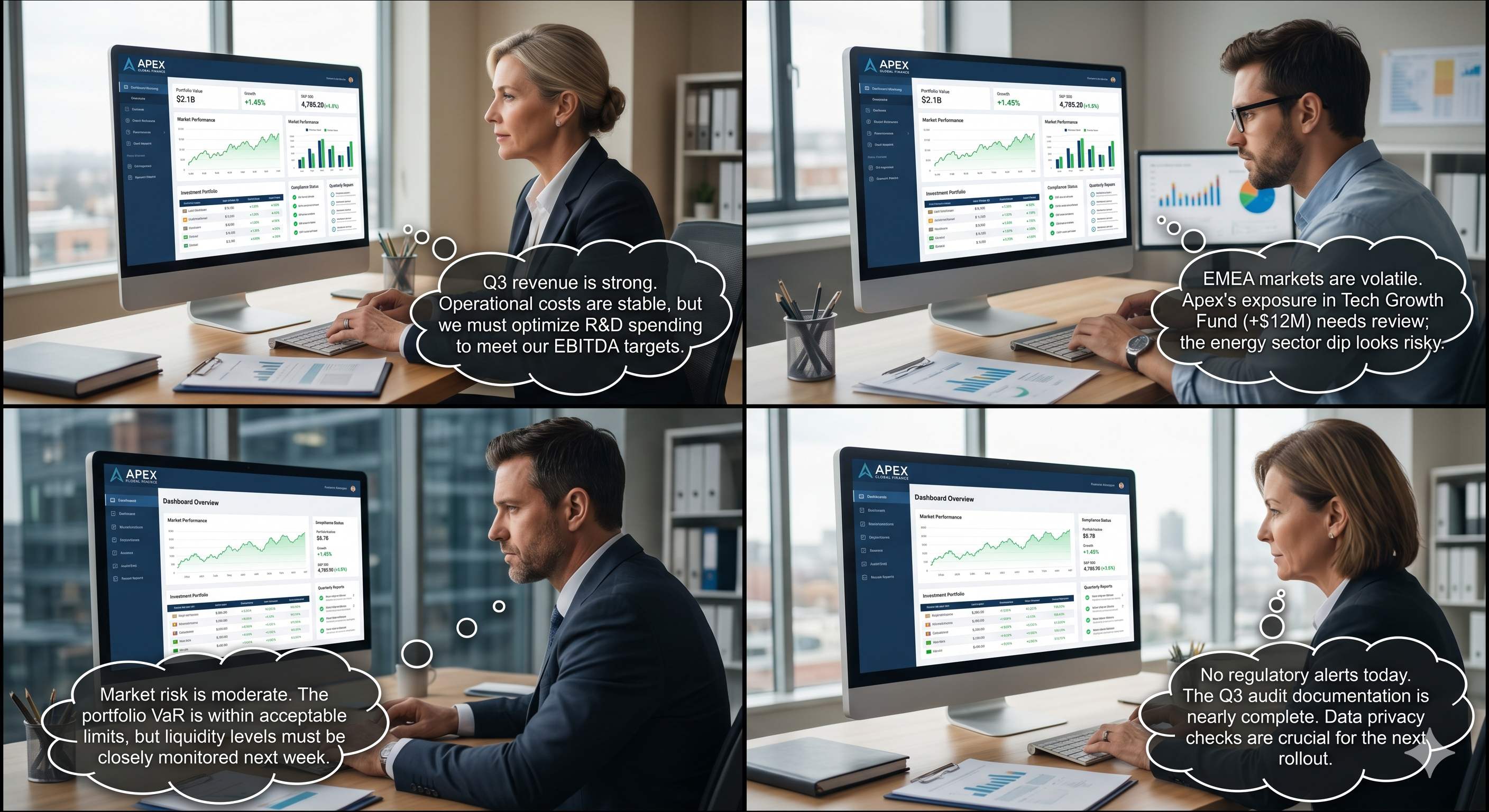
Selling into finance is selling into a buying committee, not a person. At any moment, four very different people are looking at your site:
The CFO. Strategic buyer. Cares about ROI, payback period, board-level narrative, and whether you replace headcount or augment it. Skims your homepage in ninety seconds and decides whether to forward it to a director. Doesn't read pricing pages — expects to negotiate.
The VP of Finance or Controller. Operational buyer. Knows the pain. Has used three of your competitors at previous companies. Wants to see specific feature comparisons, integration depth (NetSuite, QuickBooks, Workday, SAP), and audit-readiness. Reads your security page and your changelog.
The FP&A or RevOps lead. Power user. Will live in your product every day. Cares about how it handles their specific workflow — close cycle, variance reporting, revenue recognition, the messy edge cases. Often the person who actually champions the purchase internally.
The accountant or finance ops manager. The skeptic. Has seen vendors over-promise. Wants to see references from peers, ideally at companies that look like theirs. Cares about implementation effort and onboarding burden more than features.
These four people see the same homepage. The CFO wants strategic ROI narrative; your power user wants workflow specifics; your skeptic wants peer references. You can't write one page that serves all of them. Most finance SaaS sites pick one buyer (usually the CFO) and lose the rest.
Why this matters more in 2026
Finance teams have never been under more pressure to consolidate their stack. The era of "we'll buy a tool for everything" is over. CFOs are getting board mandates to cut SaaS spend by 20-30% even while their teams ask for more tooling. Every new finance SaaS purchase now has to clear a higher bar — not just "does this solve a problem," but "does this replace something we already pay for."
In this environment, the buyer who lands on your homepage is not in a buying mood. They're in a justification mood. They need to leave your site with a story they can tell internally. If your homepage doesn't help them build that story — with the specific ROI numbers, the specific integration list, the specific replacement narrative — they'll bounce and pick the vendor whose site did.
And on the other side, outbound to CFOs has become functionally impossible. Their inboxes are saturated. They have AI assistants triaging messages. The chance of a cold email getting through and converting is approaching zero. The buyer who chooses to visit your site is now twenty times more valuable than the one your SDR cold-emails — because they've made the first move.
You can't afford to waste them.
Why the usual fixes don't fix this
The standard finance SaaS playbook:
"We added an ROI calculator." Helpful for the CFO, useless for the power user. And most ROI calculators are interactive marketing exercises that produce numbers no one believes.
"We hired more SDRs." SDR sequences targeting CFOs have a sub-1% reply rate in 2026. The buyer is reading their email through an AI filter that flags your message as low-priority before it ever lands.
"We added gated content — whitepapers, benchmark reports." Finance buyers download these. They almost never convert from them. The gate trains the buyer to give a junk email address.
"We made the demo flow shorter." The buyer didn't want a demo. They wanted to compare you to NetSuite Advanced Financials, and your homepage didn't give them what they needed to do that.
The deeper issue: finance buyers don't convert from a single homepage visit. They convert from a multi-week research cycle that touches your site five to ten times. If every visit looks the same, you waste every visit after the first.
A Harvard Business Review study found firms that contacted potential customers within an hour of a query were nearly 7 times as likely to qualify the lead as those that waited even an hour later — and more than 60 times as likely as companies that waited 24 hours or longer. That penalty is bad for any B2B funnel, but it's catastrophic for finance, where the CFO who didn't get a fast response moves on to the next vendor in their evaluation set and rarely comes back.
What needs to happen instead
The unlock is treating each visit as a continuation of the research cycle, not as a discrete event.
When a visitor lands on your finance SaaS site, three things should happen inside the first second:
- The system identifies their company using IP intelligence — the cost has dropped from six-figure ABM contracts to commodity pricing.
- It enriches the company record with firmographic data: company size, revenue range, ERP/accounting system in use, finance team headcount.
- It scores them against your ICP and starts watching behavior: which pages, how long, what they click, whether this is their first visit or their fifth.
Then, when intent shows, the experience adapts.
A CFO at a 1,200-person company who's visited the pricing page twice gets a panel offering a fifteen-minute call with your founder and a one-page ROI summary tailored to their company size.
A Controller at a Series C SaaS company who came from a Google search for "[competitor] vs [you]" gets the comparison table with the integration depth they care about — the one you've never wanted on your homepage because it's too detailed for casual visitors.
An FP&A lead who's been on your /workflows page for four minutes gets a recorded product walkthrough of the specific workflow they're examining, plus a Slack invite to your customer community.
A finance ops manager from a customer that already uses NetSuite gets a customer story from another NetSuite shop their size, with the implementation timeline laid out clearly.
When the ICP score is high enough — the CFO at the 1,200-person company on their second visit — your Slack lights up. "Acme Corp. CFO. Series D, $40M ARR, NetSuite shop. Second visit, four minutes on the pricing page. Want to jump in?" You're in the chat in one click. The AI says: "Hold on — Yura, our founder, just joined the conversation."
The buyer isn't expecting it. That's the point.
The math for finance SaaS
Let's run it conservatively.
Say you're a Series B finance SaaS company getting 8,000 unique monthly visitors. Say 1.2% currently convert to a demo request — realistic for finance, where the consideration cycle pushes most buyers to research silently. That's 96 demos a month.
Industry data shows conversion lift ranging from 40 percent to 3.5 times when you layer real-time engagement, personalization, and smart follow-up. McKinsey research finds that companies excelling at personalization generate 40 percent more revenue than average players. Most companies publishing those numbers are only doing one or two of those things. They're not running the full cycle.
Even at the floor — a 30% lift, which is what we target with our pilots — that's another 29 demos a month, on the same traffic, same product, same team. At finance SaaS ACVs (typically $30K-$150K), that lift adds roughly $1-3M of pipeline a year. For a Series B, that's the difference between a flat quarter and a strong one.
A note on who we're built for
Finance SaaS is one of the categories where Alphie's economics work best. The deal sizes are large enough to justify the engagement layer. The buying committees are heterogeneous enough that personalization matters. The research cycles are long enough that you get multiple shots at the same buyer — and a layer that remembers them across visits compounds.
Several of our pilot customers sell into finance teams. We were founded by a YC alum and we work with several other YC SaaS companies. If you're selling to CFOs and finance ops, we've already done the work to understand how your buyers research.
The demo takes fifteen minutes and shows Alphie running against your own site.

Yura Riphyak
Yura is building the future of intelligent GTM at Alphie. Previously, he co-founded YouTeam (YC W18, acquired by Toptal) and Hubbub.fm.
Shorten the CFO Sales Cycle
See how Alphie helps finance SaaS companies convert CFOs who evaluate tools through spreadsheets, not demos.