Selling Customer Success Tools to Teams That Have Heard Every Pitch
If you sell software to customer success or support teams — CS platforms, helpdesks, knowledge bases, customer health scoring, AI support agents, voice-of-customer tools, retention analytics — you're selling into a category that's been over-promised and under-delivered for over a decade.
Heads of Customer Success and Heads of Support have heard it all. "Reduce churn by 20%." "Deflect 80% of tickets." "Predictive health scoring." "AI-powered support agents that replace 3 humans." Most of these claims under-delivered, and the buyer who lands on your homepage in 2026 has internalized that pattern. Their default skepticism isn't unreasonable — it's earned.
This makes the 95% problem especially sharp in CS and support tooling. The qualified buyer has real pain (retention, ticket volume, NPS), real budget (CS budgets are growing while sales budgets are flat), and real urgency (their board is asking about retention). But they bounce off your homepage because they've seen the pitch before, in nearly the same words, from your direct competitor.
The four people visiting your CS/support homepage
CS and support buying spans a committee that's broader than people realize:
The VP of Customer Success or Head of Support. Strategic buyer. Reports to the CRO or COO. Cares about retention, NRR, NPS, ticket deflection, and CS team productivity. Skims your homepage for outcome claims and immediately pattern-matches against the dozen vendors who promised the same thing.
The CS Operations or Support Operations lead. Operational buyer. Owns the day-to-day stack. Cares about integrations (Salesforce, HubSpot, Zendesk, Intercom, Gainsight if they're escaping it), data quality, and whether your tool will require six months of implementation.
The CSM or support manager. Team-level buyer and champion. Will live in your product with their team. Cares about whether the tool actually changes day-to-day work or just creates more dashboards. The skeptic who kills deals when the demo doesn't match the marketing.
The individual CSM or support agent. Power user. Will use your tool every day. Cares about UX, speed, whether it integrates with how they already work, and whether their job gets better or worse. Adoption-driven contracts (most CS/support tools) live or die on whether this person likes the product.
Same homepage. The VP wants the retention/deflection story. The Ops lead wants the integration matrix. The manager wants the workflow demo. The agent wants the UX video. Most CS tooling sites pick one (usually the VP) and lose the rest.
Why this matters more in 2026
CS and support are in the middle of two simultaneous shifts.
First, AI has completely reshaped the support category. AI agents are deflecting tickets that humans used to handle. AI is rewriting macros, summarizing tickets, drafting responses, identifying churn risks. Every CS/support vendor has added "AI-powered" to their homepage. The buyer can no longer differentiate vendors on AI claims alone — they've heard them all. They're now looking for substance: how the AI actually works, what data it's trained on, what the failure modes are.
Second, CS is under board pressure. After years of being treated as a cost center, CS has become a retention strategy line item. CROs care about NRR. Boards ask about gross retention. The CS leader who lands on your homepage isn't browsing — they're shopping with intent because their next board meeting depends on showing retention improvement.
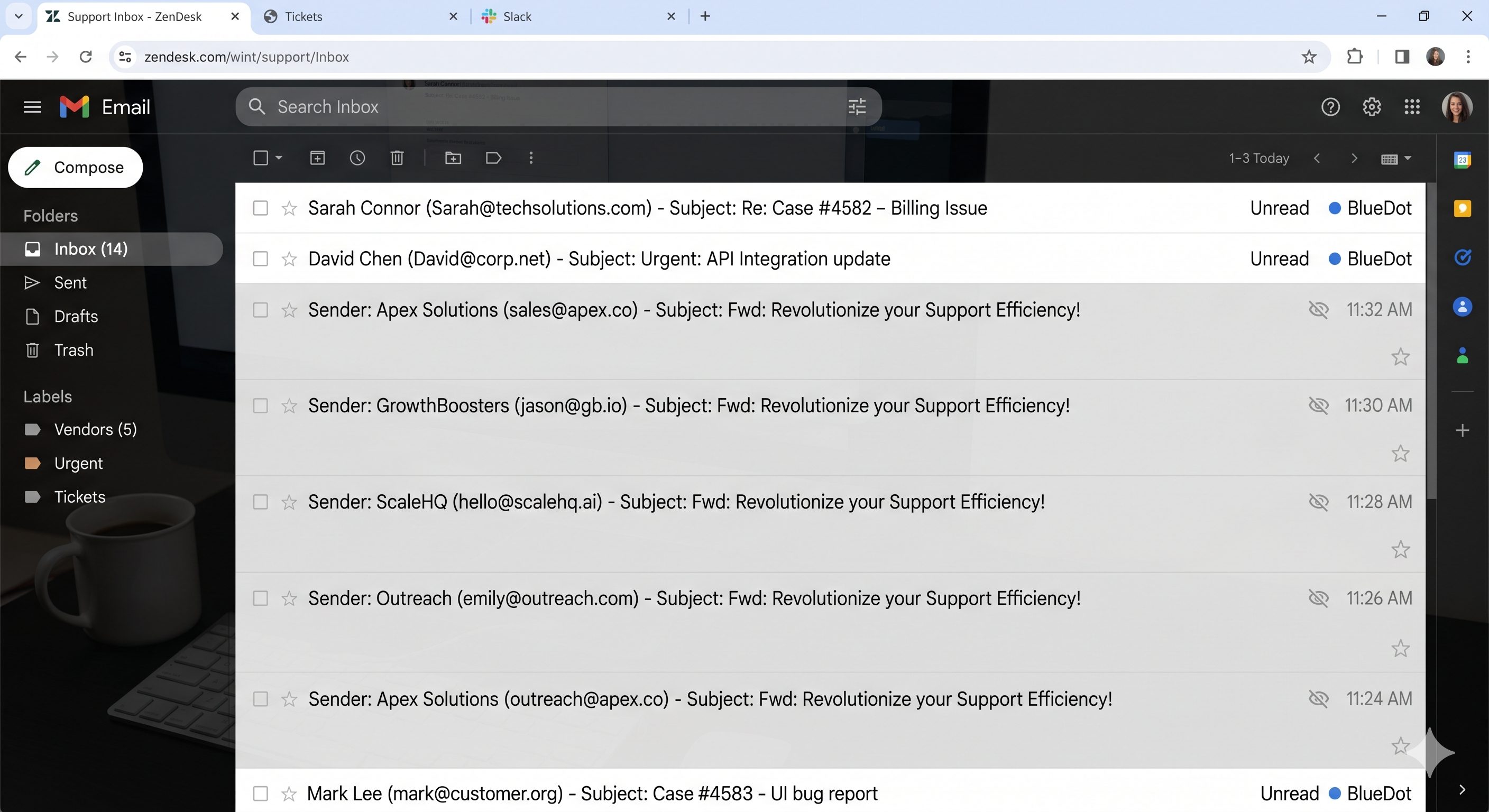
On the outbound side: CS leaders get pitched daily. Their inboxes are saturated. The buyer who chooses to visit your site is now the only meaningful inbound channel for many CS tooling companies, which makes wasting them more expensive than ever.
Why the usual fixes don't fix this
The standard CS tooling playbook:
"We added retention case studies." Helpful, but generic retention claims ("reduced churn by 20%") aren't differentiating anymore. Every vendor publishes those numbers. The buyer doesn't believe them.
"We added an AI feature to the product and the homepage." Most CS vendors have. The buyer notices but doesn't differentiate — everyone has AI now.
"We hired more SDRs to chase identified visitors." Snitcher or 6sense identifies the company, your SDR runs a sequence the next day. The VP of CS already has thirty unread CS-vendor emails. Yours doesn't get opened.
"We added gated content — retention benchmarks, customer health frameworks." CS leaders download these. They almost never convert. The gate trains the buyer to use a junk email.
"We made the demo shorter." Helps the few who book demos. Doesn't help the 95% who never book one because they couldn't tell from your homepage whether your product fit their company stage, segment, or stack.
The deeper issue: CS buyers can't easily evaluate vendors on the homepage. The actual differentiation is in how your tool behaves under their specific conditions — their data, their workflows, their team. Most CS homepages talk about generic outcomes; they don't help the buyer imagine the specific outcome they'd get with their specific business.
What needs to happen instead
The unlock for CS tooling is making your homepage substantively different for different visitors — because the buyer has seen so many CS vendor homepages that cosmetic differentiation reads as noise.
When a visitor lands on your CS/support site, three things should happen inside the first second:
- The system identifies their company using IP intelligence — now commodity pricing.
- It enriches the company record with firmographic data: company size, business model (B2B SaaS vs. B2C vs. marketplace), current CS stack signals.
- It scores them against your ICP and watches behavior.
Then the experience adapts.
A VP of CS at a Series C B2B SaaS company gets a panel showing your case study from a similar B2B SaaS company at the same stage — with specific NRR or expansion outcomes, not generic "20% retention improvement."
A Head of Support at a marketplace company who clicked into /ai gets a deeper walkthrough of how your AI handles their kind of ticket complexity (marketplace disputes are different from SaaS bugs).
A CS Ops lead who's been on /integrations for three minutes gets the deeper integration map for their stack — specifically the Salesforce or HubSpot custom objects your tool writes to.
A CSM from a customer using your competitor gets a migration story and a comparison addressing the specific limitations of that competitor.
When the ICP score crosses the threshold — VP of CS at the right company size, second visit, four minutes on /pricing — your Slack lights up. You're in the chat in one click. The AI says: "Hold on — Yura, our founder, just joined the conversation."
For CS and support leaders — who measure success in seconds-to-response — this moment is especially credibility-building. The fast founder appearance is the strongest possible signal that your product will deliver the responsiveness it's promising.
The math for CS/support tooling
Let's run it conservatively.
Say you're a Series B CS tooling company getting 14,000 unique monthly visitors. Say 1.5% currently convert to a demo or trial. That's 210 conversions a month.
Industry data shows conversion lift ranging from 40 percent to 3.5 times when you layer real-time engagement, personalization, and smart follow-up. Even at the floor — a 30% lift — that's another 63 conversions a month. CS tooling ACVs typically run $25K-$80K for mid-market and $150K+ for enterprise. Sixty-three extra monthly conversions translate to $2-7M of incremental ARR annually.
For a category where deals turn on whether the buyer believes you'll deliver on responsiveness and retention promises, the structural inbound conversion lift is high-leverage.
A note on who we're built for
CS and support tooling is one of the categories where Alphie's math compounds especially well. The buyer skepticism is high (they've heard every pitch). The multi-stakeholder dynamic (VP / Ops / manager / agent) demands substantive personalization. And the structural irony — selling responsiveness tools through unresponsive sales motions — means the founder-in-chat moment is unusually credibility-building.
Several of our pilot customers sell into CS and support teams. We were founded by a YC alum and we work with other YC CS tooling companies. If you're building in this space, we understand the skeptical buyer, the over-promise category history, and why generic AI claims no longer convert.
The demo takes fifteen minutes and shows Alphie running against your own site.

Yura Riphyak
Yura is building the future of intelligent GTM at Alphie. Previously, he co-founded YouTeam (YC W18, acquired by Toptal) and Hubbub.fm.
Stop Losing CS Buyers to Earned Skepticism
See how Alphie helps CS tooling companies break through buyer skepticism with real-time engagement.